
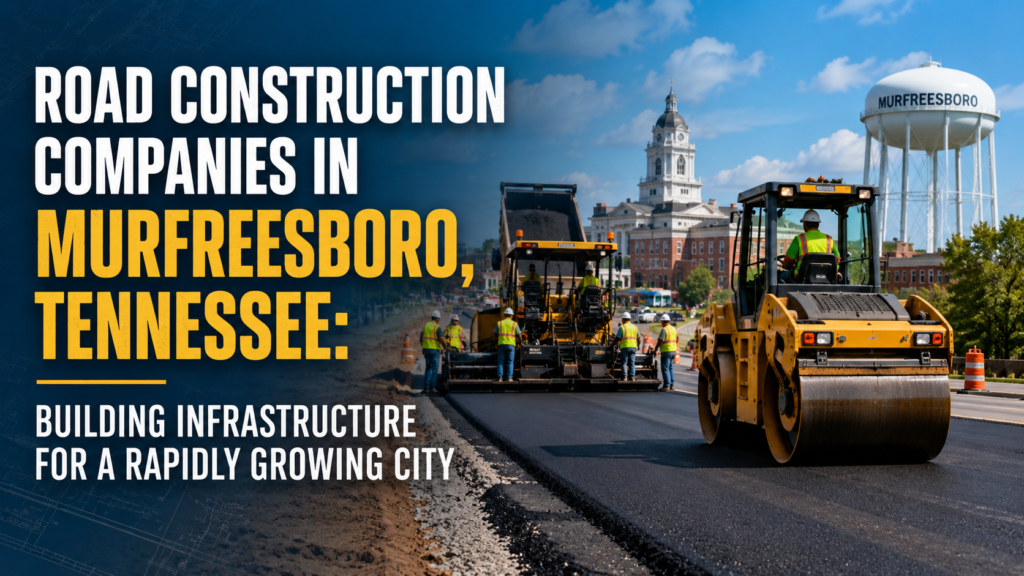
Murfreesboro’s growth story is one of the most dramatic in the American South. From a mid-sized university city of around 100,000 residents in 2010, Murfreesboro has grown to more than 200,000 people and continues to expand, making it consistently one of the fastest-growing cities in the country. This population growth drives housing development, commercial expansion, and most visibly road construction. New subdivisions need internal road networks. Commercial developments need access roads and parking infrastructure. Expanding business districts need street capacity improvements. And the city’s existing road network, built for a much smaller population, requires constant maintenance and upgrade. Road construction companies in Murfreesboro are at the center of all this activity, building and maintaining the infrastructure that makes the city’s growth functional.
What Road Construction Companies Do
The scope of road construction is substantially broader than most residents or property owners recognize. A full-service Road Construction Company Murfreesboro provides:
- New road construction: Building complete road systems from raw ground clearing and grading, drainage infrastructure installation, sub-base preparation, base course placement, and asphalt paving.
- Road reconstruction: Removing and rebuilding existing roads that have experienced base failure or structural deterioration beyond the capacity of overlay or resurfacing to address.
- Road resurfacing and overlay: Applying new asphalt surface courses over structurally sound existing road bases to restore surface quality and extend service life. This is the most common form of road improvement work on Murfreesboro’s existing network.
- Asphalt milling: Grinding the existing road surface to a specified depth using cold planing equipment in preparation for overlay, maintaining proper elevation at curbs, drainage inlets, and railroad crossings.
- Drainage infrastructure: Installing storm drains, culverts, catch basins, and stormwater management systems that protect the road from water damage Middle Tennessee’s significant rainfall makes drainage engineering central to every road project.
- Curb, gutter, and sidewalk construction: Building the concrete edge infrastructure and pedestrian facilities that define developed road cross-sections.
- Traffic control planning: Designing and implementing safe traffic management plans that maintain access for the traveling public while construction proceeds.
- Pavement marking: Applying lane lines, stop bars, crosswalks, and directional arrows following paving completion.
The Road Construction Process: From Ground to Surface
For property developers, HOA managers, and property owners planning new road construction in the Murfreesboro area, understanding the sequence of road construction phases helps set realistic expectations:
- Geotechnical investigation: Before design or construction begins on significant road projects, soil investigation determines the bearing capacity and drainage characteristics of the native soil. This data directly affects the required sub-base depth and design.
- Design and permitting: Road construction in Murfreesboro requires coordination with the City of Murfreesboro Public Works Department, and potentially with Rutherford County or Tennessee Department of Transportation (TDOT) depending on the road classification and location. Engineering drawings and permit applications must be submitted and approved.
- Clearing and grubbing: Vegetation, stumps, and surface material are removed from the road alignment.
- Sub-grade preparation: The native soil is shaped, compacted, and tested to verify bearing capacity. Soft spots are excavated and replaced with engineered fill.
- Drainage installation: Storm drains, culverts, and drainage channels are installed before the road base is placed.
- Aggregate base course: Crushed stone base material is spread and compacted in layers to the design depth. In Middle Tennessee, limestone aggregate from local quarries is the standard base material.
- Asphalt surface course: Hot mix asphalt is placed in one or more lifts depending on the road classification and design traffic loading, then compacted with steel drum rollers.
- Finishing: Curbs, sidewalks, pavement markings, and signage are completed.
Private Road Construction in Murfreesboro’s Subdivisions
A significant portion of road construction activity in the Murfreesboro area involves private roads the internal street networks of residential subdivisions, apartment communities, industrial parks, and commercial developments that are maintained by property owners or HOAs rather than by the city or county.
Private road construction in Murfreesboro’s active development market follows the same fundamental sequence as public road construction but may be governed by subdivision development agreements and the City of Murfreesboro’s private road standards rather than TDOT specifications. HOA communities that maintain significant road infrastructure must plan for periodic resurfacing in their reserve fund allocations road surfaces in Middle Tennessee’s climate typically require resurfacing every 15 to 25 years depending on traffic volume and maintenance history.
Tennessee DOT Standards and Their Influence
Road construction companies in Murfreesboro that perform work on public streets or state-maintained roads operate under the standards of the Tennessee Department of Transportation (TDOT). TDOT publishes Standard Specifications for Road and Bridge Construction that govern material specifications, installation methods, and quality testing requirements for all aspects of road construction on Tennessee’s public road network.
TDOT’s asphalt specifications for Middle Tennessee specify performance-grade binders appropriate for the region’s temperature range hot enough to resist rutting in summer, yet flexible enough to resist cracking in winter cold and aggregate gradations appropriate for Middle Tennessee’s limestone-rich geology. Road construction companies with TDOT project experience apply these specifications even on private road projects as the established regional quality benchmark.
Drainage: The Defining Challenge of Middle Tennessee Road Construction
Tennessee’s approximately 50 inches of annual rainfall distributed relatively evenly throughout the year with notable summer thunderstorm activity makes drainage engineering one of the most important determinants of road construction quality in Murfreesboro. Roads that fail to manage water effectively fail prematurely: water saturates the sub-base, reduces bearing capacity, infiltrates cracks, and accelerates the freeze-thaw damage that Middle Tennessee’s winters deliver each year.
Effective road drainage in Murfreesboro requires attention at multiple levels:
- Crown and cross-slope: The road surface must be shaped to shed water to the sides rather than allow it to stand on the travel surface. Standard road crowning in Middle Tennessee is typically 2 percent cross-slope on each side of the centerline.
- Roadside ditches: Open channels alongside the road intercept surface runoff and convey it to culverts, storm drains, or detention features.
- Culverts: Where drainage channels or waterways cross under a road, culverts sized for the design storm event prevent water from backing up against the road embankment and causing washouts.
- Sub-surface drainage: In areas with high water tables or poor-draining soils, perforated drainage pipe systems beneath the road base intercept groundwater before it saturates the base material.
- Stormwater management: For larger road projects, engineered stormwater management systems detention ponds, bioretention areas may be required by Murfreesboro stormwater ordinances to manage the increased runoff generated by new impervious road surfaces.
Murfreesboro’s Infrastructure Investment
The City of Murfreesboro has made significant public investment in road infrastructure to accommodate its growth, including capacity expansions on key corridors and an active Capital Improvements Program that includes resurfacing of city streets on a rotating schedule. This public investment creates a regular market for road construction contractors and sets a visible standard for road quality that influences the expectations of private developers and property owners as well.
For commercial developers, the proximity of a project to existing road infrastructure and the condition of that infrastructure directly affects development viability. Road construction companies that understand Murfreesboro’s road network, its growth pattern, and the city’s development approval process are well-positioned to assist developers in planning road infrastructure that meets both current needs and long-term capacity requirements.
Conclusion
Road construction companies in Murfreesboro are essential infrastructure builders for one of Tennessee’s most dynamic growth communities. From new subdivision road networks and commercial development access roads to the resurfacing and reconstruction of the city’s existing street network, these companies build and maintain the infrastructure that makes Murfreesboro’s remarkable growth story livable. Understanding what road construction involves from geotechnical investigation and drainage design through TDOT-standard material specifications and the paving sequence helps property owners, developers, and HOA managers approach road infrastructure planning with the realistic expectations and technical awareness that good infrastructure requires.